
Website Design for Family Offices: Credibility Without Disclosure
· Seichō
Family offices occupy a peculiar position in the digital landscape. Most businesses want more visibility. Family offices want precisely the right amount: enough to establish credibility, not so much that it creates exposure.
This tension shapes every decision about the website, from information architecture to visual design to how many pages actually need to exist. Get it wrong and you either look like you are hiding something or you reveal more than you should.
Why a family office needs a website at all
The instinct toward privacy is sound. Family investment offices are not consumer brands. They do not need lead generation funnels, keyword-stuffed blog posts, or social media integration. The audience is small, specific, and usually arrives at the website already knowing who you are.
But they will check. Potential co-investors, financial advisors, prospective partners, sometimes regulatory bodies. The website is not a sales tool. It is a reference point. A due diligence checkpoint.
When we built the site for Breezemount Group Holdings, the brief was explicit: design a credible digital reference point, not a sales funnel. The site exists so that when someone searches for the firm before a meeting, what they find matches the seriousness of the conversation they are about to have.
The absence of a website, or the presence of a poor one, creates a specific kind of doubt. Not “this company cannot afford a website” but “what are they not taking seriously?” In a space where trust is the operating currency, that doubt is expensive.
What makes family office websites different
Most website design advice assumes the goal is maximum engagement: more pages, more content, more time on site, more conversions. Family office websites invert these assumptions.
The audience is already qualified. You are not attracting strangers through search. You are reassuring people who already have a reason to look. This changes everything about how you structure information and design user journeys.
Restraint signals competence. In investment and private wealth, the firms that shout the loudest are rarely the ones managing the most capital. A website with twelve pages of generic content and stock photography of handshakes signals the opposite of what you intend. Brevity and deliberate omission signal confidence.
Privacy is a feature, not a constraint. Most brands try to be as transparent as possible. Family offices need to be selectively transparent. The website must communicate what the firm does and why it is credible without exposing specific holdings, deal flow, or family details that should remain private.
The audience reads differently. Co-investors and advisors are pattern-matching for substance. They will notice and respect a site that says enough without saying too much. They will also notice and distrust a site that tries too hard or communicates nothing at all.
Information architecture: what to share and what to withhold
This is where most family office websites fail. Either they default to a generic corporate template (about us, services, team, contact) that says nothing meaningful, or they overcompensate with too much detail about holdings and performance.
The right approach is purposeful selectivity.
Portfolio breadth without specific holdings. Communicate the categories and sectors you invest in. Commercial property, financial investments, strategic acquisitions. Let people understand the scope and approach without creating a target list. Breezemount’s investment page presents portfolio categories and investment philosophy without naming individual assets.
Leadership through narrative, not profiles. Detailed bios with headshots and LinkedIn links are standard corporate practice. For a family office, narrative is often more appropriate. Reference the people behind the business through the story of the firm, its values, and its track record rather than a grid of faces and titles.
Heritage as credibility proof. Track record is the most powerful trust signal a family office can deploy. If the firm has been operating for decades, that history is an asset. Present it as evidence of the discipline, judgement, and stability that underpin the investment approach.
Approach without methodology. Investors want to understand your philosophy. They do not need, and should not see, your proprietary evaluation frameworks or due diligence checklists. Communicate the principles that guide decisions without revealing the process itself.
Contact without accessibility. The site should make it possible to get in touch without suggesting that anyone can walk in the door. A simple contact form or email address is sufficient. No chatbots. No booking calendars. No “schedule a free consultation” CTAs.
Design principles for private investment
Visual design in this sector carries more weight than in most. The aesthetic is itself a communication: it tells the visitor what kind of firm they are looking at before they read a single word.
Colour and typography signal positioning. Deep, considered colour palettes (navy, charcoal, slate) communicate seriousness without being severe. Restrained typography with generous spacing signals that the content has room to breathe. Avoid gradients, bright accents, and anything that reads as startup energy.
For Breezemount, the deep navy palette with measured typography was a deliberate choice. It positions the firm alongside established investment houses rather than the logistics brand it evolved from.
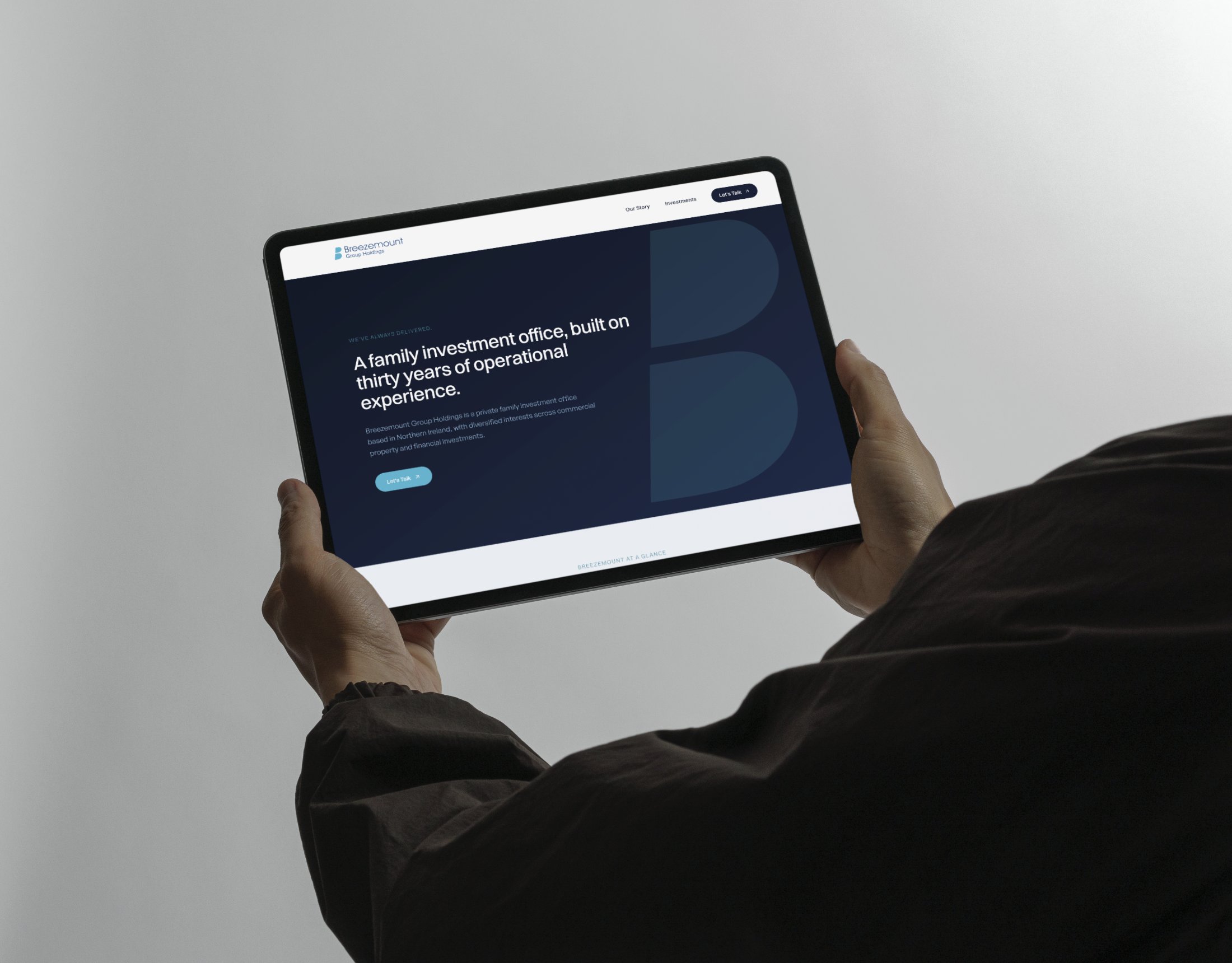
Space signals confidence. Dense layouts packed with content suggest a firm that is trying to justify its existence. Generous whitespace, purposeful layouts, and content that earns its place suggest a firm that is secure in its position. Every section on the page should answer a question a stakeholder would actually ask. Anything else is filler.
Photography should be specific. Stock imagery is instantly recognisable and instantly undermines credibility. If you use photography, make it real: your buildings, your locations, your heritage. Breezemount’s fleet photograph anchors the story in reality. It says “this is where we came from” more convincingly than any paragraph of copy could.

Fewer pages, higher quality. Four pages that say everything are better than twelve that say nothing. A family office site rarely needs more than a landing page that communicates positioning, an investment or portfolio page, a story or heritage page, and a contact page. Additional pages should only exist if they serve a specific, defensible purpose.
When the brand does not match the business
Many family offices evolved from operational businesses. Property development companies that became holding companies. Trading firms that became investment vehicles. Logistics operations that transitioned into diversified portfolios.
When the business changes but the brand does not follow, the website becomes a liability. Visitors see one thing and hear another. The brand communicates the energy and visual language of the previous business while the content tries to describe the current one.
This is a brand repositioning challenge before it is a web design challenge. The strategic work of deciding what the brand carries forward, what it sheds, and how it bridges the transition needs to happen before any design begins. We have written about why brand strategy comes before website design, and family offices are perhaps the clearest illustration of the principle.
Without strategic clarity, you end up with a website that looks appropriate for the sector but communicates nothing meaningful about why this firm, specifically, deserves attention.
Technical decisions that matter
Family office websites are not complex builds, but the technical choices still reflect on the firm.
Performance is non-negotiable. A slow site signals carelessness. The audiences visiting these sites are time-poor and intolerant of friction. Fast load times, no unnecessary animations, no bloated frameworks.
Static architecture where possible. A family office website rarely needs a CMS, dynamic content, or server-side rendering. A static site is faster, more secure, more reliable, and cheaper to maintain. If the content changes once a quarter, a static build deployed on a CDN is the right technical choice.
Security is assumed. You will not get credit for having a secure website. You will lose trust if you do not. SSL certificates, proper headers, no unnecessary third-party scripts. These are baseline requirements, not features.
Mobile is mandatory. Partners check your website on their phone in the back of a taxi on the way to a meeting. The site needs to be as considered and functional on a mobile screen as on a desktop.
Getting it right
The best family office websites share a quality that is difficult to articulate but immediately recognisable: they feel appropriate. Not flashy, not generic, not trying to be something they are not. They communicate exactly what the firm wants to communicate and nothing more.
Achieving this requires strategic clarity before creative execution. A brand audit establishes where the current brand stands relative to the firm’s actual positioning and audience. From there, information architecture, visual design, and content strategy follow from strategic decisions rather than aesthetic preferences.
The investment in getting this right is modest relative to the cost of getting it wrong. In a space where a single partnership can be worth millions, the website should never be the reason someone hesitates.