
Why Industrial Suppliers Get Filtered Out Before the First Phone Call
· Seichō
There is a point in every industrial supplier’s commercial cycle where the buyer has already made a decision, and the supplier does not know it has happened.
It is not the quote stage. It is not the first sales call. It is the ninety seconds a production manager or procurement specifier spends on the supplier’s website before deciding whether the company is worth a conversation. If the site fails that test, the supplier is not in the shortlist. They are not even aware they were considered.
This is the most expensive silence in B2B manufacturing. And it is almost entirely fixable.
The buyer has already qualified you
The modern industrial buying cycle is front-loaded. By the time procurement or engineering picks up the phone, they have shortlisted three to five suppliers, and most of that shortlisting happened online. Your website is not a brochure the buyer reads after the relationship starts. It is the qualification test they run before deciding whether to start a relationship at all.
Production managers, specifiers, and procurement teams all behave the same way at this stage. They want to answer a short list of questions quickly.
Can this company actually do the work we need? What scale do they operate at? Does the work they have completed look like the work we are commissioning? Will they handle a tender-scale job, or will we end up managing them through every step? Is their operation serious, or does it look like a one-person workshop with a WordPress site?
Most industrial websites do not answer these questions. They describe the company in the language of marketing. They lead with values, not capability. They show stock images of factory floors rather than the company’s actual work. And the buyer moves on, quietly.
Why this is a commercial problem, not a marketing problem
It is tempting to treat the website as a brand issue. It is not. The consequences are commercial, measurable, and compounding.
The buyers who filter you out before the first call are almost always the buyers you most want to win. Large precast plants, civil contractors, OEMs, and tier-one manufacturers run disciplined supplier selection processes. They cannot afford to take a chance on a supplier whose digital presence suggests they cannot scale, cannot document, or cannot deliver to specification. They will quietly choose the competitor whose website removes the uncertainty.
The enquiries that do reach you are therefore skewed. Smaller jobs. Buyers with lower requirements. Margins that reflect the pool you are fishing in rather than the work your operation can actually handle. Meanwhile, the company down the road with a credible site is quoting the bigger contracts and growing into them.
This gap does not close by itself. Every month that passes, more procurement teams run the same silent qualification test, and the supplier with the stronger digital presence compounds their advantage.
What the credibility filter is actually testing
Buyers are not consciously running a checklist. They are pattern-matching on signals that, to them, read as either serious or not serious. These signals are predictable.
Evidence of real work. Not stock photography. Not conceptual illustrations. Actual photographs of actual jobs, shot with intent, with enough detail that a buyer can assess the work against their own specification. Industrial credibility lives in the details, and the details cannot be faked.
Specification-level detail. Tolerances, capabilities, materials, finishes, capacity. Procurement teams want to know what you can and cannot do before they enquire. Generic language about “quality” and “innovation” is a signal that the company either does not know its own operation well, or does not trust the buyer to understand it.
Restraint, not performance. Industrial buyers respond to confidence, not enthusiasm. Hero carousels, animated graphics, and aspirational copy all signal a company that is working hard to appear capable. Quieter sites that show the work and let it speak read as more credible, because the buyer’s instinct is that real operations do not need to shout.
Clear service structure. If your business has two or three distinct service lines, they need to be separated cleanly. A buyer looking for one service should not have to parse the other two to find what they need. Buyers who have to work to understand your offer will not do it.
A route to enquiry that respects the buyer’s process. Procurement sends drawings. Specifiers want to scope jobs. Contact forms that demand a phone number and a “how did you hear about us” dropdown before offering a file upload signal a company that has not thought about how its buyers actually work.
What changes when the filter passes
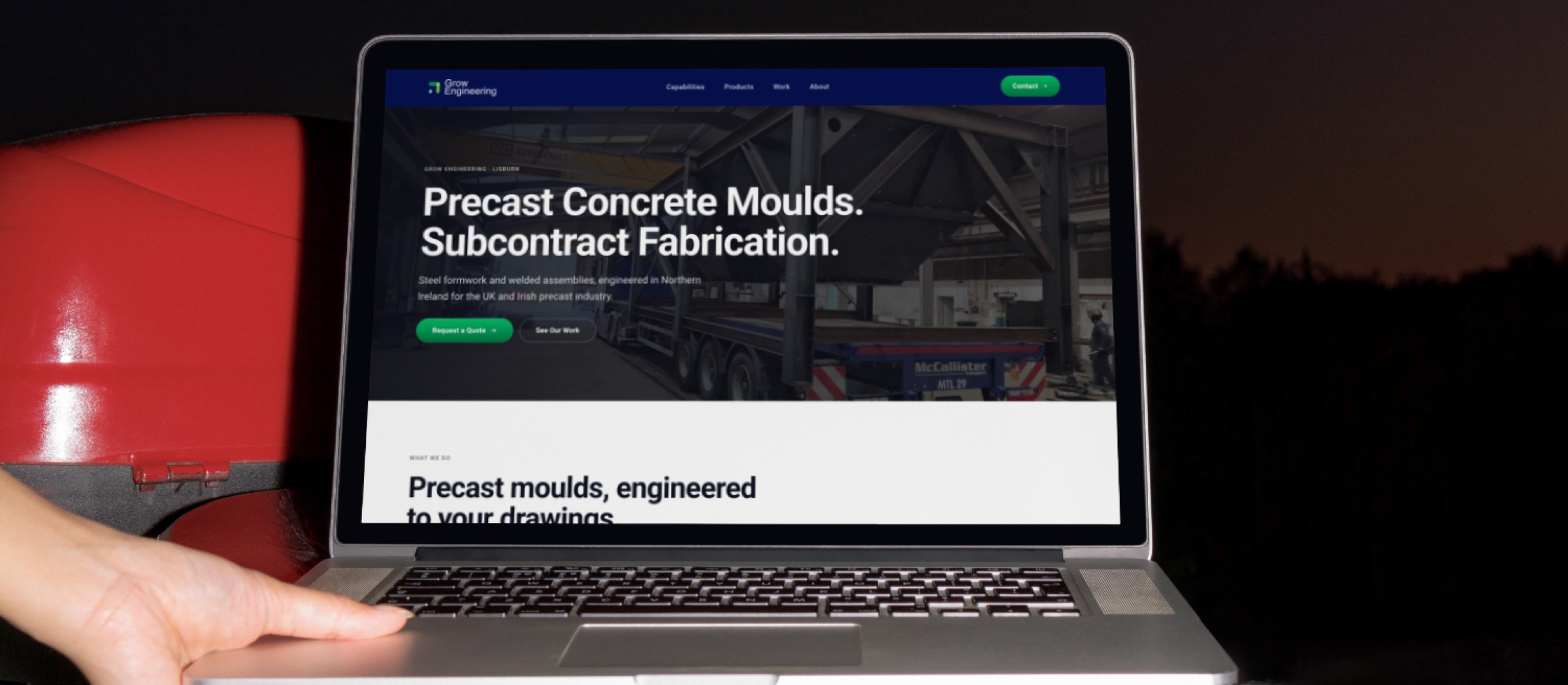
We recently worked through exactly this brief with an engineering manufacturer whose workshop capability had outgrown the credibility their digital presence was signalling. The commercial effect of closing that gap is immediate and tangible.
First calls start warmer. The buyer has already seen enough to take you seriously. The conversation begins at “what’s the lead time on a batch like this” rather than “can you actually do this kind of work.” The sales cycle compresses. Pricing discussions begin from a stronger starting point, because the supplier is no longer being measured against the commodity pool.
Shortlist access opens up. Larger tenders, longer contracts, more strategic suppliers invited into scoping conversations. The quality of enquiry rises. The operations team spends its time on live opportunities rather than triaging the inbox.
The sales team stops having to justify the business in every conversation. The website has already done that work before the conversation began. The sales function can focus on the parts of the deal that actually need a human: scoping, relationship, technical clarification, and close.
Over time, the site compounds. Every job shipped becomes a piece of sales collateral. Every case study narrows the gap between the work you do and the work buyers believe you can do. The credibility asset grows without the sales team having to re-prove the business at every touchpoint.
How to know where your site sits
The fastest diagnostic is to open your website and read it as if you were a procurement manager with a tender in hand and fifteen minutes to shortlist three suppliers.
Can they answer, in under a minute, what you make, for whom, to what scale, and at what specification? Is there real evidence of completed work that looks like the work they are commissioning? Does the site look like it belongs to a company that could handle the job they are scoping, or does it look like a smaller operation than the capability behind it?
If the honest answer is no, then the commercial problem is not in your sales team. It is upstream of them. And it is quietly costing the business more than anything else in the commercial stack.
The investment case
Closing the credibility gap is one of the highest-leverage pieces of commercial work an industrial supplier can do. The cost is knowable. The work ships once and compounds over years. The return is the category of contracts that were previously invisible to the business, and the margin profile that comes with them.
There is no single marketing channel, sales hire, or trade-show schedule that will deliver that same effect. The website is the only commercial asset that every serious buyer is guaranteed to interact with before the first conversation. When it is doing its job, it is the cheapest salesperson the business will ever have. When it is not, it is the most expensive.
The suppliers that take this seriously now will be the ones invited into the tender conversations the next generation of buyers shortlists from. The suppliers that wait will find the gap has widened, and closing it has cost more than it would have today.