Bespoke event management platform: from spreadsheets to a unified system
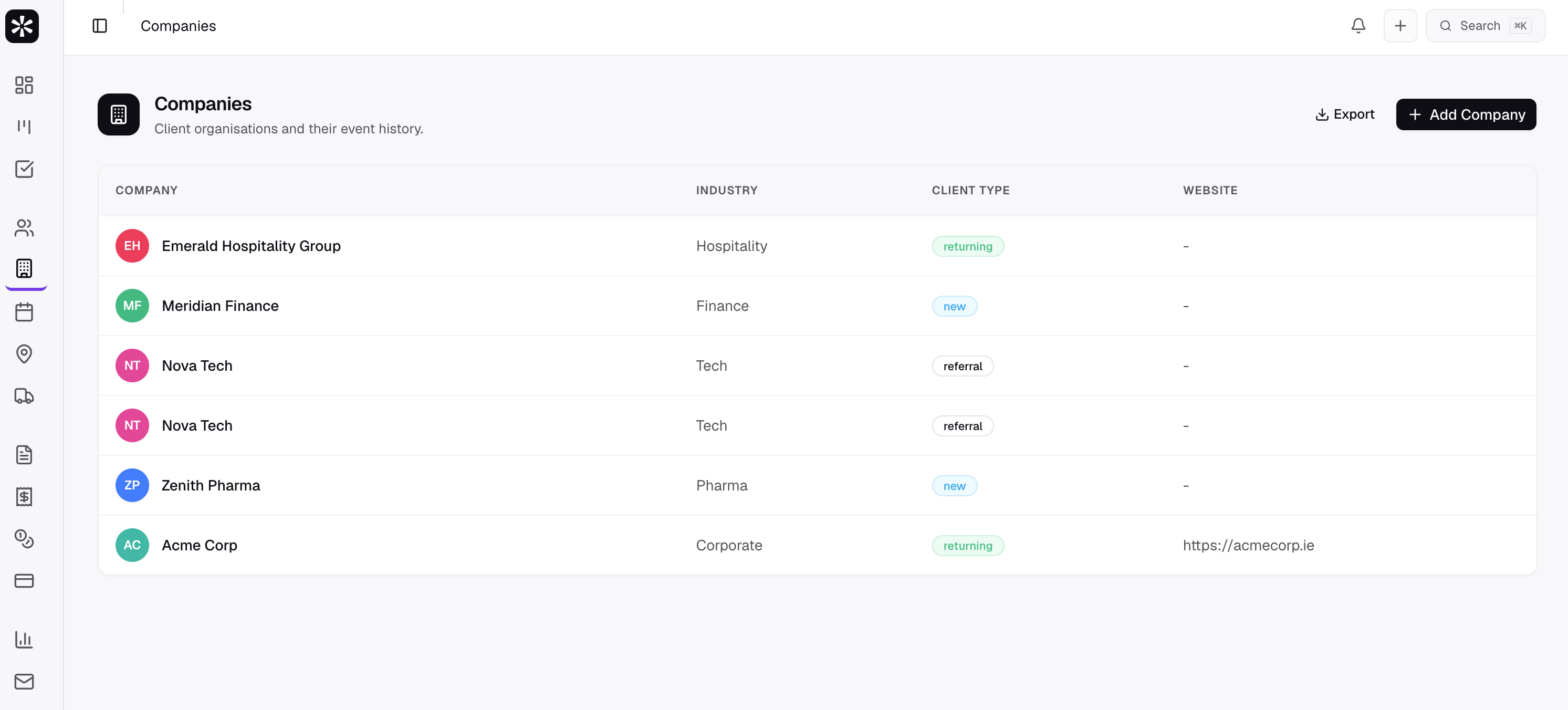
An event management company running corporate events, conferences, and team-building experiences across Ireland, the UK, and Europe had outgrown its tooling. Operations ran on spreadsheets, Google Forms, and manual email workflows. As the business grew, the fragmented approach could not keep pace with the complexity of multi-role teams, financial tracking, and client management.
A bespoke event management platform that unifies the entire event lifecycle, from lead capture through to post-event feedback, with role-based access control, real-time pipeline management, and offline-capable event check-in.
Platform replacing 12+ disconnected tools
Team roles with tailored access
Event check-in without WiFi
The problem
The client had built a successful business managing corporate events, holiday parties, conferences, and team-building experiences. But behind the scenes, every process depended on manual work.
Leads came through Google Forms. The pipeline lived in spreadsheets. Quotations were assembled by hand. Guest lists were managed in disconnected documents. Financial tracking required cross-referencing multiple sources to understand margins, commissions, and outstanding invoices. As the team grew and events scaled in complexity, this patchwork could not keep up.
The business needed a single platform that could manage the full event lifecycle, enforce financial accuracy, and give every team member access to exactly the information their role requires.
Platform architecture
We built the platform on Next.js 15 with Supabase as the backend, giving the team a modern application stack that is fast to develop against and straightforward to maintain. The database layer uses PostgreSQL with row-level security policies, meaning data access rules are enforced at the database itself, not just in the application code.
The architecture was designed around one principle: every team member sees exactly what they need, and nothing they should not. A finance manager sees margins and commissions. A project lead sees client-facing costs but not internal ones. An event producer sees guest lists and agendas but no financial data. This is not cosmetic UI hiding. It is enforced at the database layer.
Sales pipeline
The pipeline replaces the spreadsheet that previously tracked every deal. Three distinct sales sequences handle different lead types: warm referrals, inbound website leads, and outbound prospecting. Each follows its own cadence with automated reminders and overdue alerts.
Deals progress through defined stages on a drag-and-drop Kanban board. Every call, email, meeting, and note is logged against the deal record, giving the team a complete activity history without anyone needing to write a summary.
Event lifecycle
Once a deal converts, the platform manages the entire event from planning through to completion. Cost sheets break down every line item with margin calculations. Venues and suppliers are managed with rate cards and room configurations. Agendas, menus, and entertainment are planned within the system.
The event status tracks through planning, confirmed, in progress, and completed, with visibility at each stage tailored to the role of the person viewing it.
Guest management and check-in
Guest lists support multiple sources: manual entry, CSV import, and RSVP responses. Each guest record tracks dietary requirements, accessibility needs, and attendance status.
The event check-in system was built for the reality of live events. Venues often have unreliable WiFi. The check-in interface works offline using IndexedDB for local storage, syncing back to the server when connectivity returns. Guests are checked in by QR code scan or PIN entry. RSVP confirmation emails include the QR code automatically.
Quotation and financial management
The quotation system generates professional documents with selective visibility. Client-facing quotes show costs to the client. Internal views show margins and commission calculations. PDF export produces branded documents ready to send.
Invoices are generated directly from approved quotes. Nominal code tracking aligns with the company’s accounting system, and commission tracking handles venue-based and supplier-based commission models. The entire financial pipeline is visible to authorised roles and invisible to everyone else.
Role-based access control
The platform implements a 10-role permission matrix that governs every action in the system. Roles range from admin and director (full access) through to event producer and creative designer (limited, task-specific access).
Permissions are enforced at two layers. The application layer checks permissions before every mutation. The database layer applies row-level security policies that prevent unauthorised reads regardless of how the request arrives. This defence-in-depth approach means a single misconfiguration cannot expose sensitive data.
Design system
The interface was designed with intention, not defaults. We moved away from generic component library styling and built a custom design system grounded in a clear principle: quiet authority with spatial clarity.
The colour system uses OKLCh colour science for perceptually uniform contrast. Colour is reserved almost exclusively for functional meaning: status badges, pipeline stages, and focus indicators. The rest of the interface relies on a carefully tuned neutral palette that keeps the focus on the data.
Typography uses Geist Sans for the interface and Geist Mono for financial figures, invoice numbers, and tabular data. Every component meets WCAG AA contrast requirements.
Email and communications
A centralised email system handles transactional messages: RSVP confirmations with embedded QR codes, viewing reminders, quote delivery, and status notifications. Email templates are managed within the platform, giving the team control over messaging without touching code.
An event landing page builder lets the team create branded event pages with configurable sections: hero images, schedules, testimonials, galleries, and call-to-action blocks. These pages serve as the public face of each event, linked directly from invitation emails.
Results
The platform consolidates what was previously spread across a dozen disconnected tools into a single system where data flows through the entire business. Leads enter the pipeline and progress through to event delivery without being re-entered at each stage.
Financial accuracy is enforced by the system rather than dependent on manual reconciliation. Role-based access means the right people see the right information without the overhead of managing separate tools and permissions manually. Offline check-in means the technology works when it matters most: on the ground, at the event, regardless of venue connectivity.
This is a system built around how the business actually operates, not a generic platform that the business must bend around.