Website rebuild engineered for organic growth and qualified enquiries for a Belfast accountancy firm
Arro Group is a Belfast accountancy practice with fifteen years in practice and over a thousand businesses advised. The brand had the credibility, the team, and the sector depth. The website did not. It was invisible on every commercial keyword that mattered, ranked for almost nothing beyond the firm's own name, and was missing the single biggest accountancy opportunity of the decade: Making Tax Digital.
A complete rebuild positioned around two commercial outcomes. Win Belfast SME enquiries through local sector-led content and a clear, conversion-focused front end. Capture the national Making Tax Digital wave through a properly structured content hub that funnels readers from informational search into local enquiry. Built on Astro 5 and Tailwind 4, designed to compound in value monthly.
Sector hubs built for depth
Service pages mapped to demand
Articles planned across 12 months
The commercial brief
Arro Group had the substance: fifteen years in practice, more than a thousand businesses advised, four sector specialisms, and a director who is genuinely respected in the Belfast business community. None of that was working for the firm online.
The existing site ranked for the firm’s own name and almost nothing else. On the keyword that matters most, “accounting firms Belfast”, Arro Group held the local pack but sat at position twenty-four organically. On every Making Tax Digital query, on every sector phrase, and on every service term, the site was effectively absent from search. New enquiries came from referral. The website was a brochure that confirmed Arro Group was real for people who already knew the name.
The brief was not to redesign the site. The brief was to build a commercial asset. The result is live at arrogroup.co.uk.
The opportunity we were buying into
Two windows opened the project.
The first is timing. Making Tax Digital for Income Tax Self Assessment went live for the £50,000-plus cohort in April 2026. The £30,000 threshold drops in April 2027. The £20,000 threshold drops in April 2028. Search demand around MTD penalties, deadlines, software, and switching is climbing month on month, with predictable spikes on every quarterly deadline and every threshold change. Almost no Northern Ireland accountancy firm has built serious MTD content. The national vendors have no NI angle. The space sits open.
The second is the local SERP. Arro Group already holds the Google local pack for “accounting firms Belfast”. Pushing the organic listings up alongside the local pack gives the firm two slots on the highest-intent SERP in the market. The page mechanics for that move were not in place on the old site.
The strategy was to build a site that could serve both: local commercial content that converts on intent, and national informational content that earns trust and routes Belfast-bound readers into enquiry.
Information architecture as a commercial decision
Every section of the site was designed around either a buying conversation or a search intent.
Sector hubs were built first because sector specialism is Arro Group’s actual moat. Hospitality, retail, construction, manufacturing, and not-for-profit each got a dedicated hub covering the sector’s accounting reality, the Northern Ireland context, the recurring challenges, and the specific questions the firm answers every week. These pages are written for the business owner reading them, not for a content marketing checklist. They double as search assets and as proof of expertise during a discovery call.
Service pages map to commercial demand rather than service-list convention. Making Tax Digital, personal tax, business accounts, VAT, payroll, corporate tax, business advisory, audit, and Companies House each get their own page, optimised for the way buyers actually search.
Switching accountants got its own dedicated page because switching is a commercial trigger that demands its own argument and its own conversion path. It removes friction that the homepage cannot.
Resources and news sit underneath everything, scaling out through the retainer.
Front-end conversion mechanics
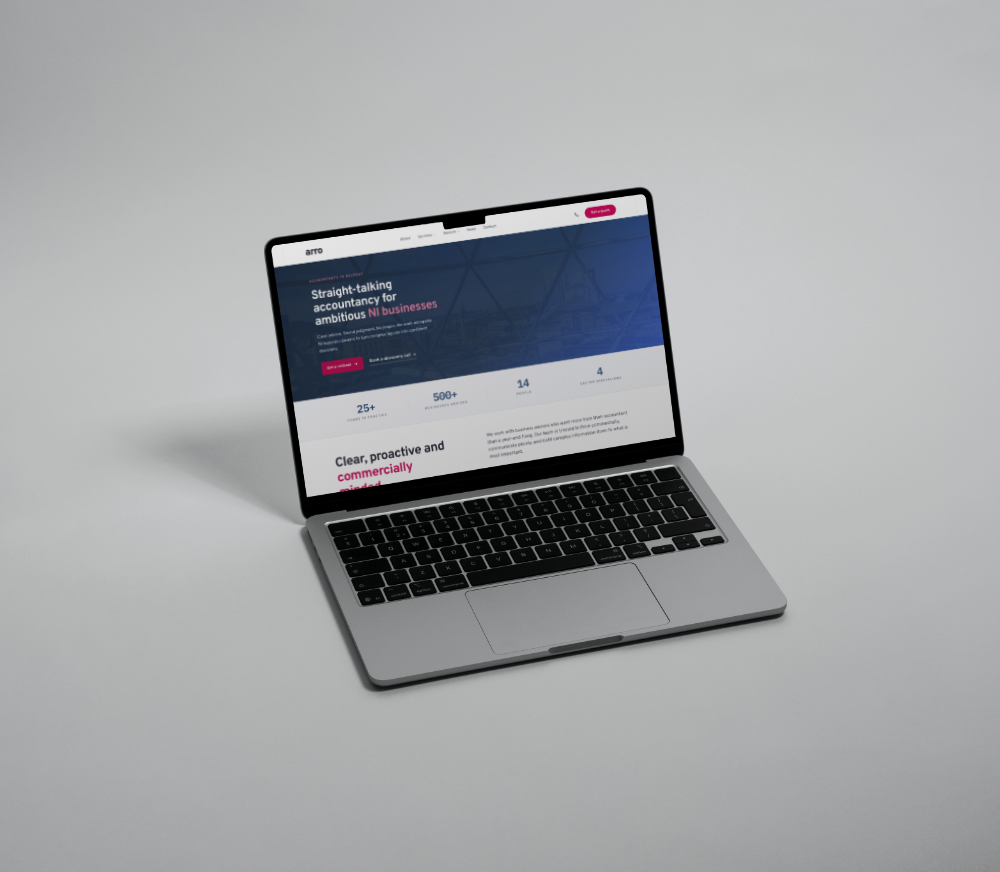
The homepage is a deliberate sequence. Hero with a single proposition. Stats bar that proves substance. About statement that does the positioning work in one block. Service grid, sector grid, pricing band, why-us, case study preview, testimonial grid, lead magnet band, CTA band. Every section is one decision the visitor is making, in order.
Two CTAs run across the site. “Book a discovery call” for high-intent buyers. “Get a callback” for buyers who are not yet ready to put time in a diary. The split lifts conversion on both ends of the funnel without forcing the lower-intent visitor into a decision they will not make.
The lead magnet band gives the firm a third capture mechanism for visitors who are not yet ready for either CTA, and feeds the email list that the content programme will warm.
Brand system: serious, modern, navigable
The brand was repositioned to look like the firm Arro Group already is. A confident lowercase wordmark. A cobalt navy primary, a burnt clay accent used with restraint, and cool slate neutrals. IBM Plex Sans across the system, set on a 1.333 type scale at 18-pixel base. Square corners on cards, rounded corners on buttons and form fields. A thin clay rule beneath every section label as the brand’s defining mark.
The aesthetic is editorial, not corporate. The site reads as a publication, not a marketing brochure. That is the right frame for an accountancy firm that wants to be seen as a thinker rather than a service provider.
The build: fast, durable, owned
The site is built on Astro 5 with Tailwind 4. Static output, self-hosted on Hetzner, no proprietary CMS, no platform lock-in. Performance is engineered into the stack rather than retrofitted. Schema, metadata, internal linking, and crawl efficiency were all built in at the architecture stage rather than added afterwards.
Editing happens in the repository. Content updates ship through a build pipeline. The cost of running the site is a Hetzner server. The cost of changing the site is a developer’s time, not a platform’s monthly fee.
The retainer: turning the site into compounding revenue
The site launches with a twelve-month content programme attached. Four articles per month, briefed in advance, sequenced around the Making Tax Digital deadline calendar and the seasonal accountancy cycle. Monthly Search Console review. Monthly conversion review. Monthly ranking review against a competitor set drawn from the actual Belfast SERP.
Forty-eight articles plus four refreshes across twelve months gives the site enough surface area to saturate the MTD sub-clusters that matter, own the sector × MTD intersection that no competitor is touching, and hit every deadline window with multiple supporting pieces. The mechanic is straightforward: national MTD article earns the visitor, trust signals on page warm them, service page positions Arro Group, local enquiry CTA closes them.
The commercial case
The site is not a cost. It is a commercial asset with three compounding returns.
Enquiry volume. Two organic slots on the highest-intent local SERP, plus a national MTD content cluster routing readers into Belfast-specific service pages, generates qualified inbound enquiries that did not exist before. The economics shift from referral-only to referral-plus-inbound.
Brand authority. Sector-led content positions Arro Group as the named NI expert in hospitality, retail, construction, manufacturing, and not-for-profit accountancy. That positioning lifts close rates on every channel, not just the website. Discovery calls start warmer. Proposals get shorter.
Compounding value. Static site, owned infrastructure, and a content engine that adds four assets a month means the site appreciates rather than depreciates. Year two compounds on year one. The cost line stays flat. The asset value rises.
Where it sits today
The site is live, the brand system is in production, and the content programme is running. The first MTD deadline in the calendar lands in August 2026. The architecture, the content cluster, and the conversion mechanics are all built to be in position when it does.